How to Choose an Explainer Video Production Company: A Buyer's Checklist
By Potto AI Team·
A buyer's checklist for choosing an explainer video production company or agency: the brief to write first, stage deliverables, revision rounds, ownership and 10 contract questions.
To choose an explainer video production company, write a one-page brief first, then compare each company on four things the sales page rarely makes explicit: the stages in its process, what you receive at each stage, how many revision rounds are included, and who owns the finished video and its source files. This checklist covers the brief to prepare before you ask for quotes, the deliverables to expect at each stage, the contract questions to ask, how to compare quotes, and when it is better to make the video yourself.
The advice applies equally to an explainer video agency, a studio and a freelance animator. It is not a ranking, and it does not name companies or quote their prices.
What an explainer video production company does
An explainer video production company turns a message into a finished video: it helps shape the idea, writes the script, designs the visuals, records or casts the narration, animates, adds music and sound, and delivers files. The terms "production company", "studio", "agency" and "services" overlap; what differs is how much of the work the provider manages for you.
Vidico's cost guide separates the routes in a useful way. It says freelancers typically leave you to manage the brief, the feedback and the timeline, studios handle strategy, scripting, storyboarding, animation, voiceover and revisions, and full-service agencies manage strategy, scripting, production and post-production end to end. That is one company's description, but the question behind it is the right one to ask every provider: which parts of this project will I be managing myself?
If you are still deciding what kind of video you need, start with what an explainer video is. This guide assumes you have decided to hire.
Company, agency or freelancer?
Freelancer. One person, often an animator or illustrator. Good for a clear brief and a defined style, with more coordination left to you.
Specialised studio. A small team with a writer, a designer and an animator, often the right size for one important video.
Full-service agency. Strategy, scripting and production for larger programmes. An animated explainer video agency fits when the work is a distinctive 2D or 3D style, custom characters or a campaign.
Size is not quality. Judge each by the checklist below.
Write the brief before you ask for quotes
A quote is only as good as the brief behind it. Three different one-line requests get you three prices for three different videos. A one-page brief makes quotes comparable. Include these items:
Brief item
What to write
Audience
Who watches, what they already know and what they are deciding
One message
The single idea the viewer should be able to repeat afterwards
Desired action
What the viewer should do next: read, sign up, book, change a habit
Length
A target length (for example 60 or 90 seconds), and whether you want shorter cut-downs as well
Where it plays
Website, sales deck, email, social feed, training portal, event screen
Formats
16:9 for websites and decks, 9:16 for phones, 1:1 for feeds
Style
Two or three reference videos you like, and what you like about each
Voice and language
Narrator tone, accent, and every language you need
Brand assets
Logo files, colours, fonts, existing illustrations
Who signs off, how many reviewers, and who has the final say
Dates
The date the video must be live and the dates your reviewers are unavailable
Budget
A range you are willing to share, so companies propose to scale
Two items matter more than the rest. The first is the single message: a video that explains the whole company usually explains none of it. The second is the approvals line. Yans Media's blog says that once a stage is approved and the studio moves on, the stage is considered finalized, so the person who can say yes should be named before the first draft, not after the third.
If you cannot state the message in one sentence, choose a company that offers discovery and scripting.
The production stages and what you should receive
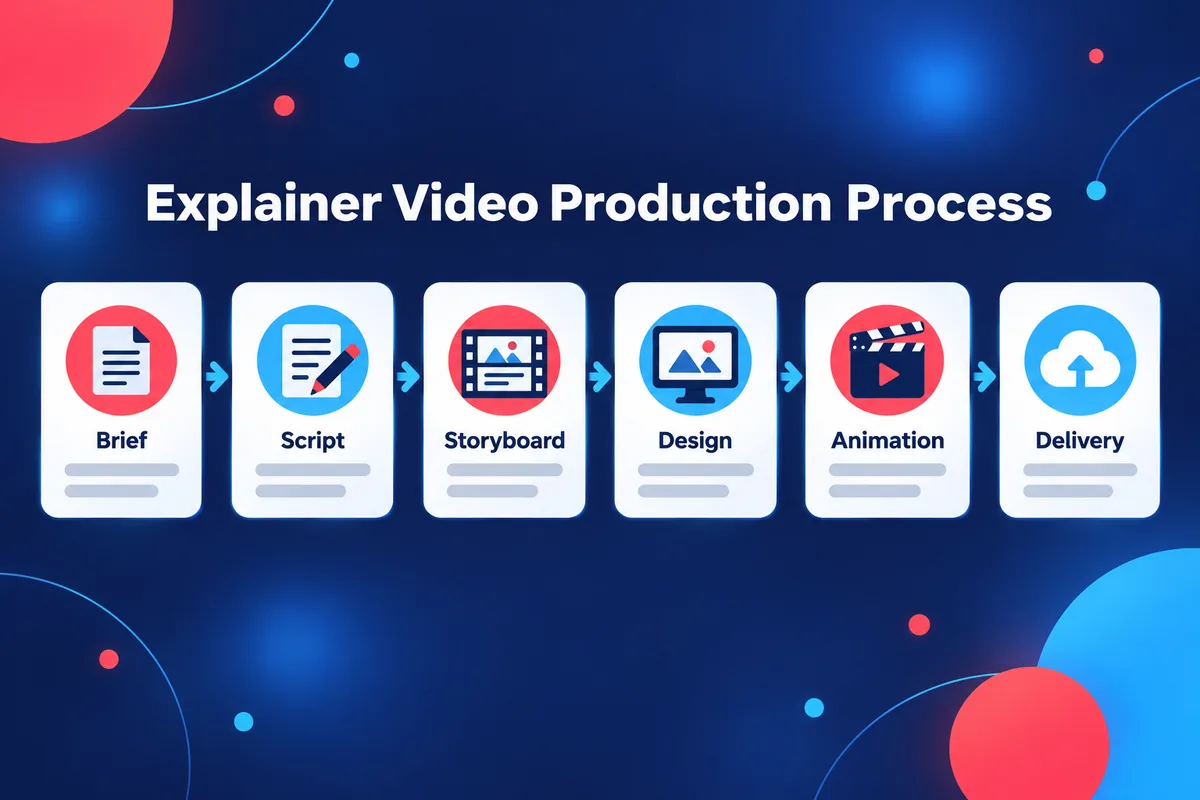
Public process pages from animation studios describe almost the same order: brief and research, script, storyboard, illustration or style frames, voice-over, animation, sound and final delivery. The number of stages varies: Yans Media's process page lists seven, Video Explainers lists five, and B2W's guide lists eight. All three put the script before the storyboard and the storyboard before the animation, and that order is the part to insist on.
Use the table below as a template for a project plan. Ask each company to fill in the right-hand columns in its own words.
Stage
What the company does
What you should receive
What you approve
Discovery
Reviews your brief, audience and competitors
A short written summary of the approach
The goal, the audience and the single message
Script
Writes narration around the message, a hook and a call to action
A script draft with revision rounds
The exact words, including names, numbers and claims
Storyboard
Maps each scene, its visuals and its timing
A scene-by-scene storyboard, sometimes with a mood board
The order of ideas and what appears on screen
Style frames and illustration
Designs two to four key frames, then illustrates the rest
Style frames, then the full set of illustrations
Look and feel, characters, colours
Voice-over
Auditions voices and records the narration
Voice samples, then the recorded track
The voice, pronunciation of product terms
Animation
Animates the approved storyboard
A draft video, usually a review link
Timing, transitions, on-screen text
Sound and finishing
Adds music, effects, captions and logo end card
Final video in the agreed formats
Final sign-off
Why the script and storyboard come first
B2W's guide says the script and storyboard stages take the most back-and-forth, and that changes are cheap at the storyboard and expensive later. Vidico's guide makes the same point in money: it says major structural changes such as rewriting the script or changing style mid-project can add 20% or more. Whatever the exact figure, the lesson holds: spend your own review time on the script and storyboard, and do not treat the animated draft as the place to change the message.
Check facts at the script stage
A studio does not know your numbers or legal wording as well as you do. Have someone on your side check every name, figure and claim when the script and storyboard arrive, because no later stage will catch them.
Ask what a "round" is
The same word, "revision", covers very different things. Changing a word of narration, swapping a colour, re-recording a voice and redrawing a scene are not the same amount of work. Ask the company to define a round as one consolidated set of feedback from all your reviewers at one stage, and to say what falls outside it.
Revision rounds: what companies publish
Revision policies differ more than almost anything else. Three public examples show the range.
Per stage, with a cap. Yans Media's process page says its studio typically offers two free revisions at every stage except the voice-over stage, which has one. Unused revisions are forfeited once a stage is approved, and unlimited revisions are available for an agreed price.
A total number in the base price. Vidico's cost guide says most studios include one to two rounds of revisions in the base price, and that each extra round adds 8% to 12%. Its FAQ phrases the standard as two rounds, so confirm the included count before you sign.
A promise without a number. Video Explainers' process page says it revises until the client is fully satisfied, with no extra charge, but does not state a number. Ask what that means in a contract.
Three questions turn a revision policy into something you can compare. Is the count per stage or for the whole project? What happens to unused rounds when a stage is approved? What triggers a change request, and how is that priced?
Ownership, source files and licences
Three separate questions hide inside "Do I own the video?"
Who owns the copyright?
In the United States, the U.S. Copyright Office explains that a commissioned work counts as a "work made for hire" only if it falls within one of nine statutory categories (which include a part of a motion picture or other audiovisual work) and both parties sign a written agreement that says so. Without that, the person who creates the work is generally the copyright owner unless they assign it in writing. Other countries have different rules, and this is general information, not legal advice. The practical point is the same everywhere: ownership should be stated in your contract, not assumed from the fact that you paid.
Will you receive the source files?
Editable project files are separate from the finished MP4, and public process pages rarely say whether they are handed over. Yans Media says it saves all assets and project files in case you want changes later, but does not say whether the client receives them. If you plan to update the video yourself or move to another provider, ask in writing which files you will get and in what formats.
What licences sit underneath the video?
A finished video contains other people's work: voice talent, music, stock footage, fonts, sometimes illustrations. Vidico notes that voice-over rates depend on usage rights, and Yans Media advises checking that a music licence matches the media and campaigns where the video will be used. Ask what each licence covers: which channels (web, paid ads, broadcast, events), which countries, and for how long. A licence that covers organic web use may not cover paid advertising.
10 questions to ask before you hire
Send these to every company you compare, and confirm anything said on a call by email.
Who writes the script, and who checks the facts? Ask whether scripting is in the quote or an add-on, whether you can supply a draft, and how corrections to names and numbers are handled.
Which stages need my written approval? Ask for the approval points in the plan and what happens to a stage once you approve it.
How many revision rounds are included at each stage? Ask what counts as a round, and what an extra round or a change to an approved stage costs.
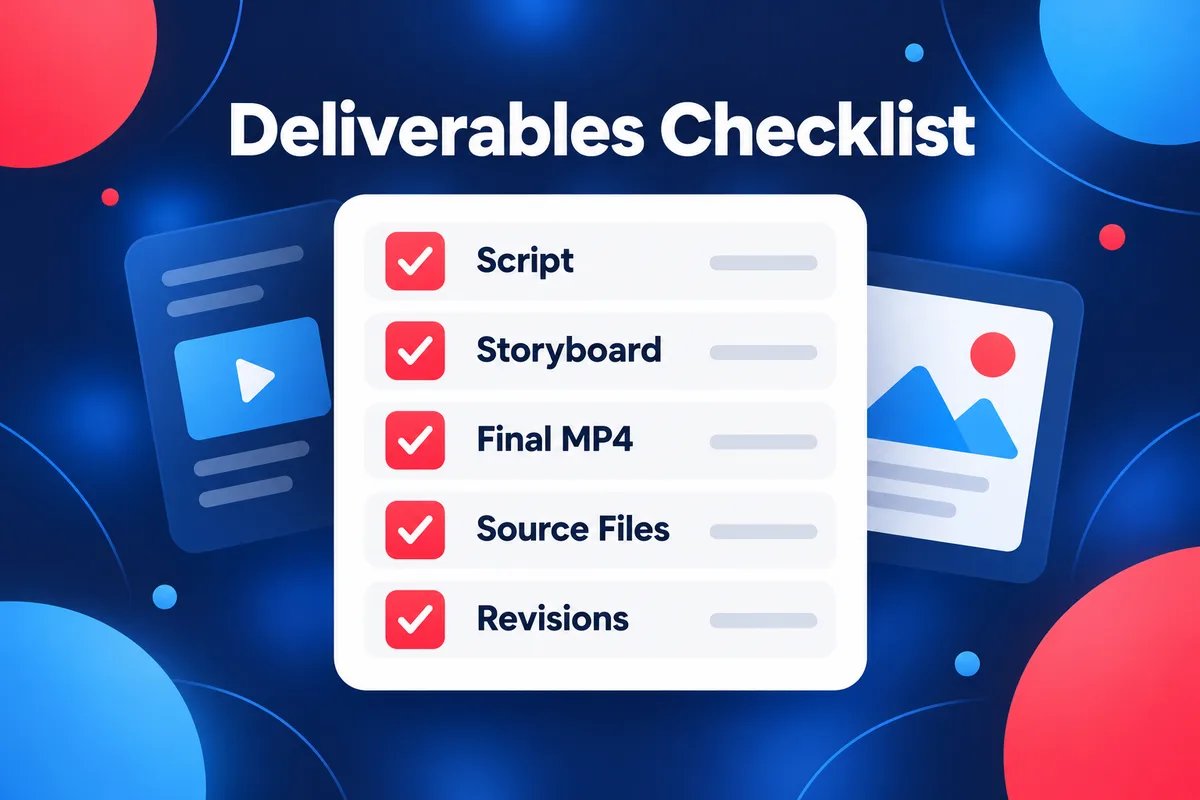
What exactly will I receive? Ask for file formats, aspect ratios (16:9, 9:16, 1:1), resolution, caption files, and any shorter cut-downs for social feeds.
Will I receive the source files? Ask for project files, separate illustrations, script, storyboard and caption file, and whether they cost extra.
Who owns the video and the artwork? Ask for a written assignment or work-made-for-hire clause that covers the animation, characters and illustrations you paid for.
What do the voice, music and stock licences cover? Ask for the channels, territories and duration, and what a renewal or extension costs.
What does the schedule depend on? Ask for dates per stage, what happens if your feedback is late, and whether the delivery date is in the contract.
Who will actually work on my project? Ask whether the writer, designer and animator are named, and whether any of the work is subcontracted.
What is not included, and what would change the price? Ask how length, extra languages, extra versions and a changed script affect the quote, and what the payment schedule and cancellation terms are.
If a company cannot answer five or six of these before you sign, expect the gaps to turn into change requests later.
How to compare explainer video production services
With the brief and the ten answers in hand, compare quotes line by line, not by total.
Make the quotes comparable
Put each proposal in the same table: script, storyboard, illustration, voice-over, music, animation, revisions, formats, source files and licences. Mark each cell as included, optional or not mentioned. A lower total often means "not mentioned" in several cells. Vidico's guide lists studio scripting, professional voice-over, custom music and extra revision rounds as separate cost items, so a proposal that bundles them is not directly comparable with one that lists them.
Read the portfolio for the right things
A portfolio shows craft, but it does not show process. Look for work that resembles your subject and your audience, and ask whether the team that made it is the team you would get. If you want a reference point for what a clear structure looks like, the breakdowns in these explainer video examples show the problem, solution, how-it-works and next-step pattern scene by scene.
Ask for a reference from a client with a similar project, and ask what that client would do differently.
Watch for common warning signs
A price with no description of what is included.
No stated revision limit, or a limit that applies only to the final stage.
No mention of who owns the artwork.
Pressure to approve the script before your reviewers have seen it.
Ask for a dated schedule rather than a headline number. B2W's guide says a professional explainer takes about 2 to 12 weeks depending on the style, and Vidico's guide says four to eight weeks is standard for a 60 to 90 second animated explainer. These are published statements, not guarantees, and your own approvals are part of the schedule.
When to hire a company, and when to make it yourself
Hire a company or agency when
The message is not settled. Discovery, positioning and scriptwriting are craft skills. If you cannot yet say the one idea in a sentence, a studio can help you find it.
You need custom characters or a distinctive style. Original characters, a hand-built illustration system or 3D are production work.
You need live action, cast voice talent or sound design. Cameras, actors and recording sessions sit outside what a self-serve tool does.
The video is a flagship. A homepage video or brand campaign that will run for years justifies a managed process and careful licensing.
Make it yourself when
The material already exists. A report, article, handout, manual or deck already holds the content; the job is turning it into scenes.
You need several videos. Training clips, onboarding steps and support answers add up when each is a separate commission.
The content changes often. If a number changes every quarter or a screen changes every month, editing a scene is simpler than commissioning a new video.
You want to see the cost before you commit. On a self-serve tool the price scales with length and is shown before you export, so there is no quote to negotiate.
A combined route
Many teams use both: a studio produces one flagship video and sets the visual direction, and the team makes everyday explainers in-house.
Explainer video creation with Potto
Potto is a self-serve tool, not a production company. Here is how it maps to the checklist above.
The explainer video maker takes a topic, notes, an article, a document, images or a webpage link and builds the video in stages you can review: a brief, an outline with visual direction, and a storyboard. Claude Opus 5.5 writes the outline, script and storyboard, and Remotion renders the motion-graphics scenes with narration, captions and music. Compared with the stage table earlier:
Script and storyboard. Both are drafted for you and shown for review. You can edit each scene's on-screen text and narration, and the project conversation handles structural changes. Writing and editing them costs no credits.
Illustration. Scenes use your source images or generated illustrations. There is no hand-drawn, whiteboard or character animation style.
Voice-over. Narration is available in 32 languages, or the language is detected automatically, with captions in the video. There is no human voice casting.
Music. Tracks come from Potto's own library of original music.
Preview and revisions. The browser preview uses no credits, and revising the script or storyboard costs no credits before you export.
Formats. You export a 1080p MP4 at 30 fps in 16:9, 9:16 or 1:1, with target lengths of 15, 30, 45, 60 or 90 seconds.
If your subject is software, the product demo video maker builds the same kind of video from a product link or your own screenshots, with real interface images as the scenes. Documents work as input too: PDF, PowerPoint and Word files up to 20 MB each, with up to 8 attachments in one project.
What it costs
Exporting is the only step that uses credits: 5 credits per second plus narration and any illustrations, and the export screen shows the total before you confirm. As worked examples from the pricing page, a 30-second product demo with no narration or illustrations costs 150 credits, and a 60-second narrated explainer with 900 narration characters and three illustrations costs 374 credits. Plans start at US$20 per month for 2,000 credits, and one-time credit packs are also available. Credits are not dollars, so check the current plan and pack details on the pricing page. Using Potto does not remove the need to ask about rights and licences either: read the terms before you publish a video commercially.
Where Potto does not fit
Potto does not provide scripting consultancy, custom character animation, live action or human voice casting, and it does not edit existing video clips. It delivers the finished MP4, not an editable animation project or code. If any of those are requirements, they belong on your company-hire list.
FAQs
What does an explainer video production company do?
An explainer video production company plans, writes, designs, animates and delivers a short video that explains one product, service or idea. Its work usually covers discovery, the script, a storyboard, illustration, voice-over, animation, music and final delivery, with a set number of revision rounds. How much of that it manages for you depends on whether it is a freelancer, a studio or a full-service agency.
How do I choose an explainer video production company?
Write a one-page brief, send it to a few companies, and compare their answers to the same questions: the stages in the process, what you receive at each stage, how many revision rounds are included, who owns the video and the source files, and which licences sit underneath the voice and music. Use the portfolio to judge craft and the written answers to judge risk.
What is the difference between an explainer video agency and a production company?
The words overlap, and there is no fixed definition. In general, a production company or studio makes the video from a brief, while an explainer video agency may also handle strategy, messaging and distribution around it. An animated explainer video agency is one that specialises in animated styles such as 2D, 3D or motion graphics. Ask each provider to list what is included instead of relying on the label.
How many revision rounds should an explainer video include?
Published policies range from one or two rounds in the base price to two revisions per stage, with one for the voice-over, so there is no single standard. Ask whether the count is per stage or for the whole project, what counts as a round, and what an extra round or a change to an approved stage costs. Gather all reviewers' feedback into one set before sending it.
Who owns the explainer video after production?
Ownership depends on your contract. Under U.S. law, a commissioned work is a work made for hire only if it falls in a listed category and both parties sign a written agreement saying so; otherwise the creator generally keeps the copyright unless they assign it in writing. Get ownership, source files and the licences for music, voice and stock material in the contract, and ask a lawyer if the video matters to your business.
Can ChatGPT create animation videos?
ChatGPT can write the script, the storyboard and the narration text for an animation video, but it does not hand you a finished, narrated explainer with consistent scenes, music and captions. You still need a video tool or a production company to turn that text into animation, so check OpenAI's current product pages for what ChatGPT itself can output today.
Can I make an explainer video without hiring a company?
Yes, if you have the source material and the video does not need custom characters, live action or cast voice talent. A self-serve explainer video maker builds scenes, narration and captions from your text, documents or screenshots, and you review and edit the result. Hire a company instead when the message is not settled or the video is a flagship brand piece.
Sources
All pages were queried on 2026-10-12.
Yans Media, "Our production process" (seven stages, deliverables, two free revisions per stage except voice-over): https://www.yansmedia.com/our-process (queried 2026-10-12)