Arm Tattoos for Men: 40 Ideas by Placement and Style
By Leo·
Arm tattoos for men by placement: forearm, upper arm, bicep, inner arm, small pieces and sleeves, with 40 ideas, styles that age well and how to plan yours.
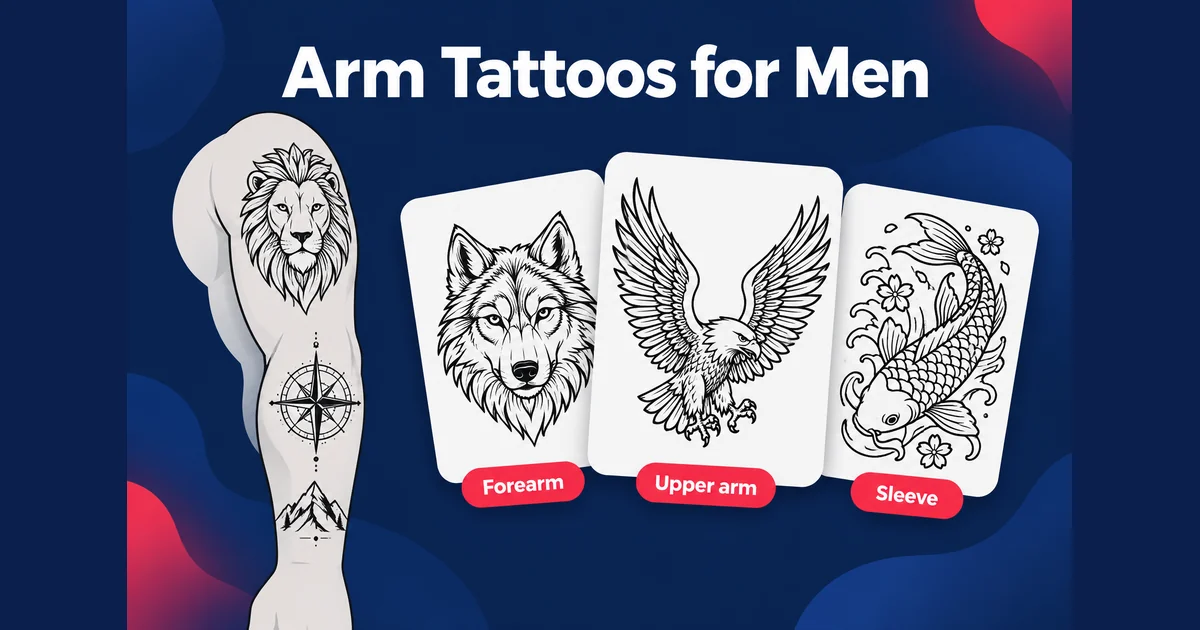
Arm tattoos for men work best when the design is chosen for its placement first and its subject second. The forearm suits long, vertical designs you will see every day; the upper arm and bicep take bigger, bolder pieces that a T-shirt sleeve can cover; the inner arm is good for private, fine-line work; small arm tattoos fit the wrist or elbow; and a sleeve links several pieces into one composition. This guide gives 40 arm tattoo ideas for men grouped by placement, explains which styles hold up as the skin ages, and shows how to turn a vague idea into a clear design before you book an artist.
Every idea below is a starting point. A good tattoo artist will redraw it to fit your arm, your skin and the space around it, and that conversation goes better when you arrive with a clear subject, a placement and a size.
How to Choose Arm Tattoo Placement
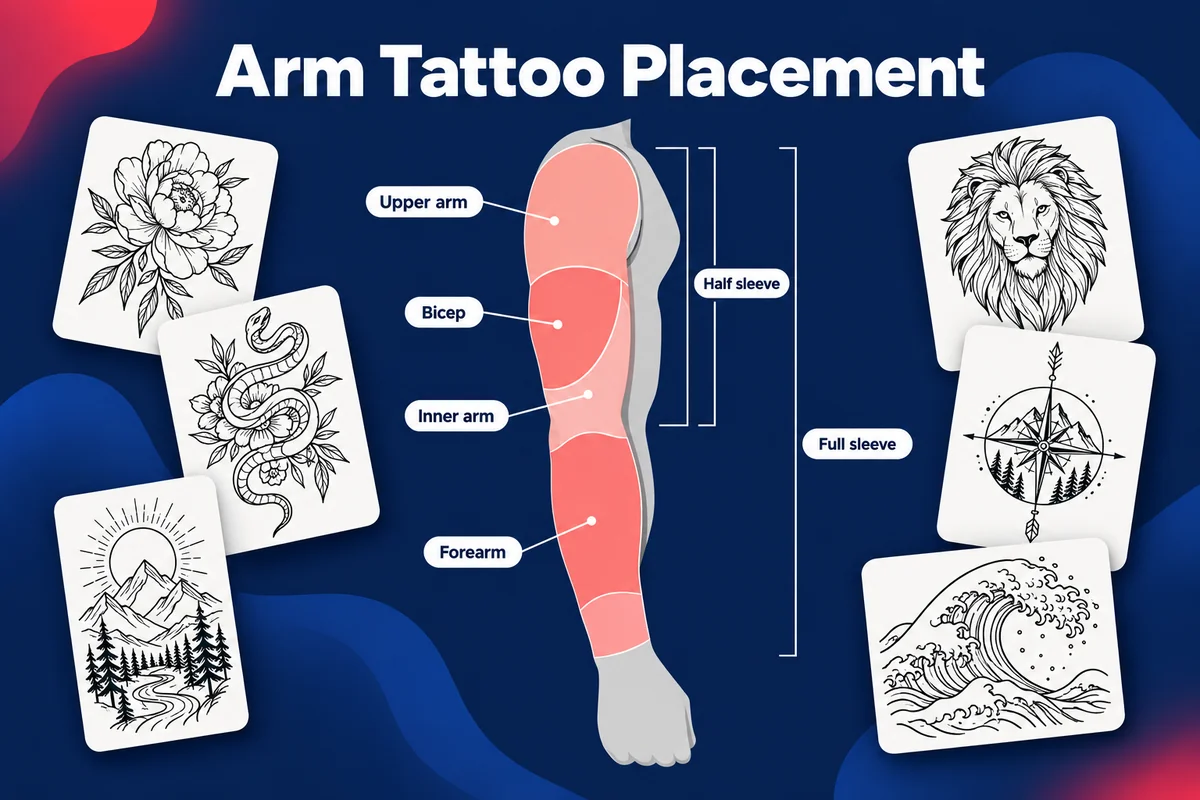
Placement decides three things before style even comes up: how often the tattoo is seen, how big it can be, and how the design has to be shaped. The arm is not a flat page. The forearm tapers toward the wrist, the upper arm wraps around the bicep and tricep, and the inner arm is narrow and soft. A design drawn for one area rarely fits another without changes.
Placement
Visibility
Typical size
Shapes that fit
Good for
Outer forearm
Seen every day, by you and others
Medium to large
Long vertical designs
Symbols, animals, landscapes
Inner forearm
Seen mostly by you
Small to medium
Narrow vertical designs
Dates, fine-line symbols
Upper arm (outer)
Hidden by most T-shirt sleeves
Medium to large
Round or square designs
Animals, portraits of objects, mandalas
Bicep
Partly hidden
Medium
Shapes that follow the muscle
Bold traditional pieces
Inner upper arm
Mostly private
Small to medium
Narrow vertical designs
Personal symbols
Half sleeve
Shoulder to elbow, or elbow to wrist
Large, several sessions
One linked composition
Themes with a background
Full sleeve
Shoulder to wrist
Very large, many sessions
One planned composition
Long-term projects
Three questions narrow the choice quickly:
Do you want to see it every day? Forearm tattoos for men are the most visible arm placement. If you would rather show it on your own terms, the upper arm and inner arm are easier to cover.
Does your work or family situation matter? Many men start with the upper arm for that reason and move down to the forearm later, which also leaves room to grow into a sleeve.
Is this a single piece or the start of a sleeve? If a sleeve is a possibility, tell the artist now. They will place the first piece so the next ones can connect to it.
Forearm Tattoos for Men
Forearm tattoos for men are the most searched arm placement, and for good reason: the outer forearm is a long, fairly flat surface that shows a design clearly, and it is easy to show or cover with a sleeve. Designs that run with the length of the arm look best here. A design that is too wide wraps around the arm and is hard to see from any one angle.
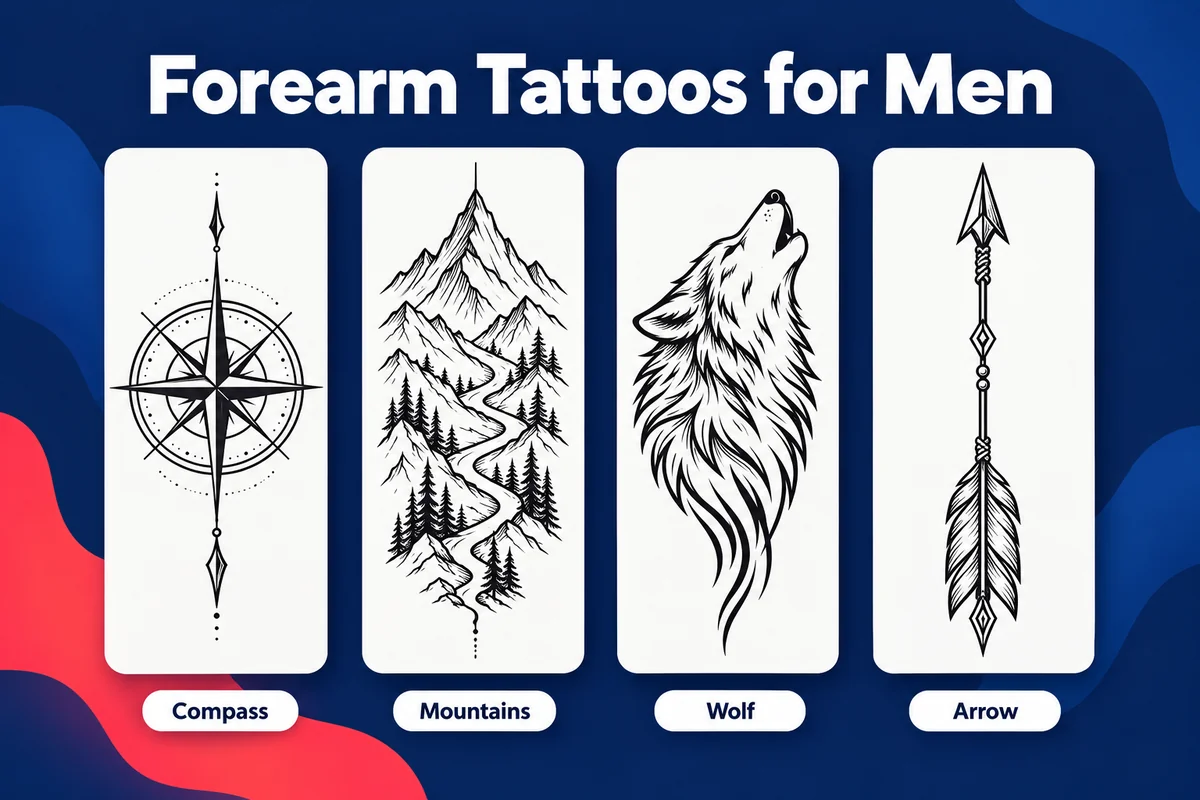
Twelve forearm tattoo ideas for men:
Compass. A classic for travel and direction. Keep the needle and the letters of the cardinal points simple so they stay readable as the lines settle.
Mountain range. A horizontal band of peaks works as a wrap-around piece; a single peak with a path running up the arm works as a vertical one.
Wolf head. Facing up the arm, with the fur drawn as strong directional lines rather than fine shading.
Arrow. One long arrow fits the forearm's shape naturally. Add a small detail at the fletching to make it yours.
Pine forest. A row of trees growing from the wrist, or a single tall pine, with negative space for the sky.
Anchor and rope. Traditional and bold. The rope can wrap around the arm to link with a future piece.
Geometric line work. Triangles, hexagons or a line pattern that follows the arm. Precise geometry needs an artist who is confident with straight lines.
Lion or tiger. A big cat head reads well on the outer forearm if the artist keeps the face simple and the mane bold.
Dagger. A vertical blade suits the shape of the arm and pairs well with a flower or a snake.
Chess piece. A king or knight is a clean silhouette with a clear meaning.
Ocean wave. A single wave in Japanese style or as a fine-line curve.
Script or date. If you add lettering, keep it large enough. Small, tight script is the first thing to blur.
The inner forearm is softer and more private. It suits the smaller items on this list, a date, a single line of text or a fine-line symbol, and it is the placement many men choose for a tattoo that is mainly for themselves.
For 50 more designs, with sizes for the outer and inner forearm, see our full guide to forearm tattoos for men.
Upper Arm and Bicep Tattoos for Men
Upper arm tattoos for men sit on the outer arm between the shoulder and the elbow. The area is large, the skin is fairly thick, and a standard T-shirt sleeve covers most of it. That combination makes it the most common spot for a first larger piece. Bicep tattoos for men sit on the front of the same area and move with the muscle, so designs that follow its curve look better than rigid shapes.
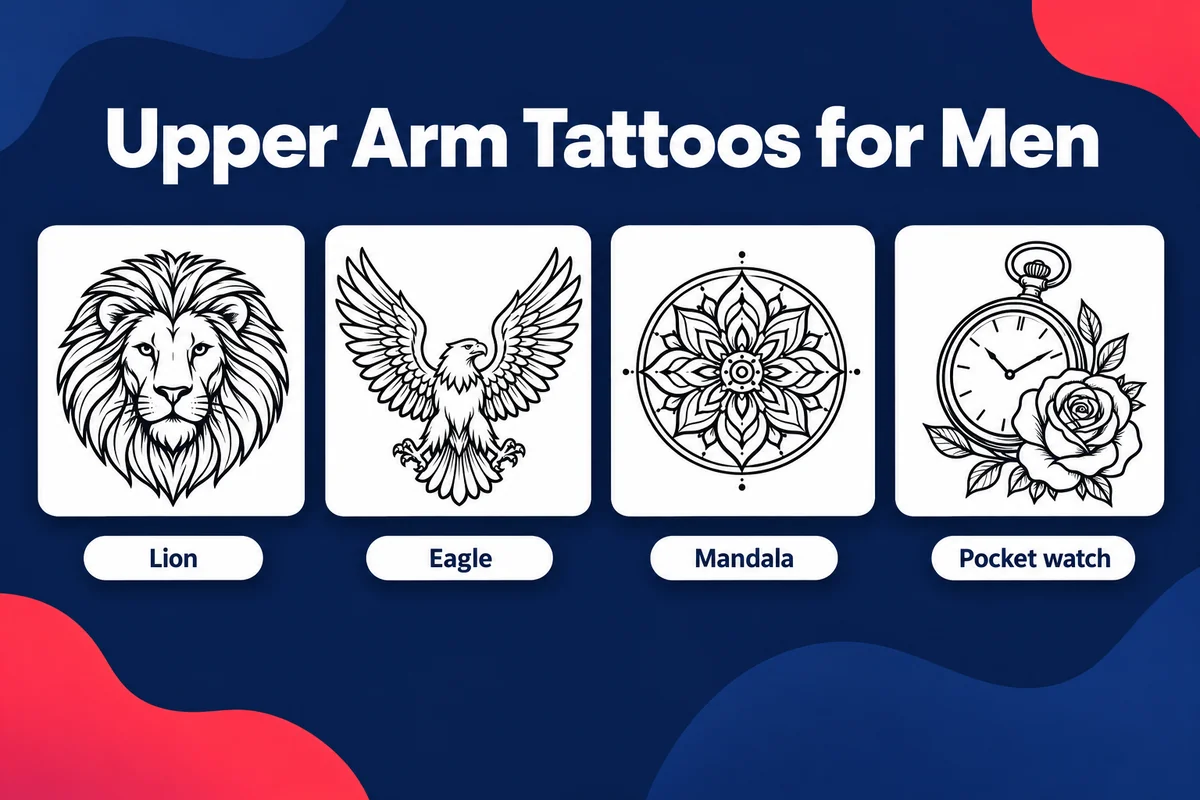
Ten upper arm and bicep tattoo ideas for men:
Lion head. The most requested upper arm subject. A round composition fits the outer arm well.
Eagle with spread wings. The wings can wrap toward the chest or the back as part of a future half sleeve.
Mandala shoulder cap. A circular pattern centred on the shoulder that flows down the arm.
Pocket watch or clock. A round object with a time that means something to you, often paired with roses.
Skull. A traditional subject with a lot of variations, from realistic to simple flash.
Samurai helmet. A strong shape for Japanese-inspired work that can grow into a sleeve.
Bear. A standing bear in profile fits the vertical space between shoulder and elbow.
Tribal band. A band around the bicep is a classic. Modern versions use thicker blackwork and more open space.
Rose and dagger. A traditional pairing that fits the outer arm in a square composition.
Family crest or emblem. Keep it simple and drop any fine detail an artist cannot keep sharp at that size.
Inner Arm Tattoos for Men
The inner upper arm is one of the more private placements on the body. It is narrow, so it suits tall, slim designs: a line of text, a single flower, a feather, a sword or a small vertical symbol. It is also one of the more sensitive spots on the arm, which matters for longer sessions, and the skin there can stretch more with weight changes. Fine-line work is popular here, but line weight should not be so thin that it fades. Ask the artist to show you healed examples of fine-line work they have done on the inner arm.
Small Arm Tattoos for Men
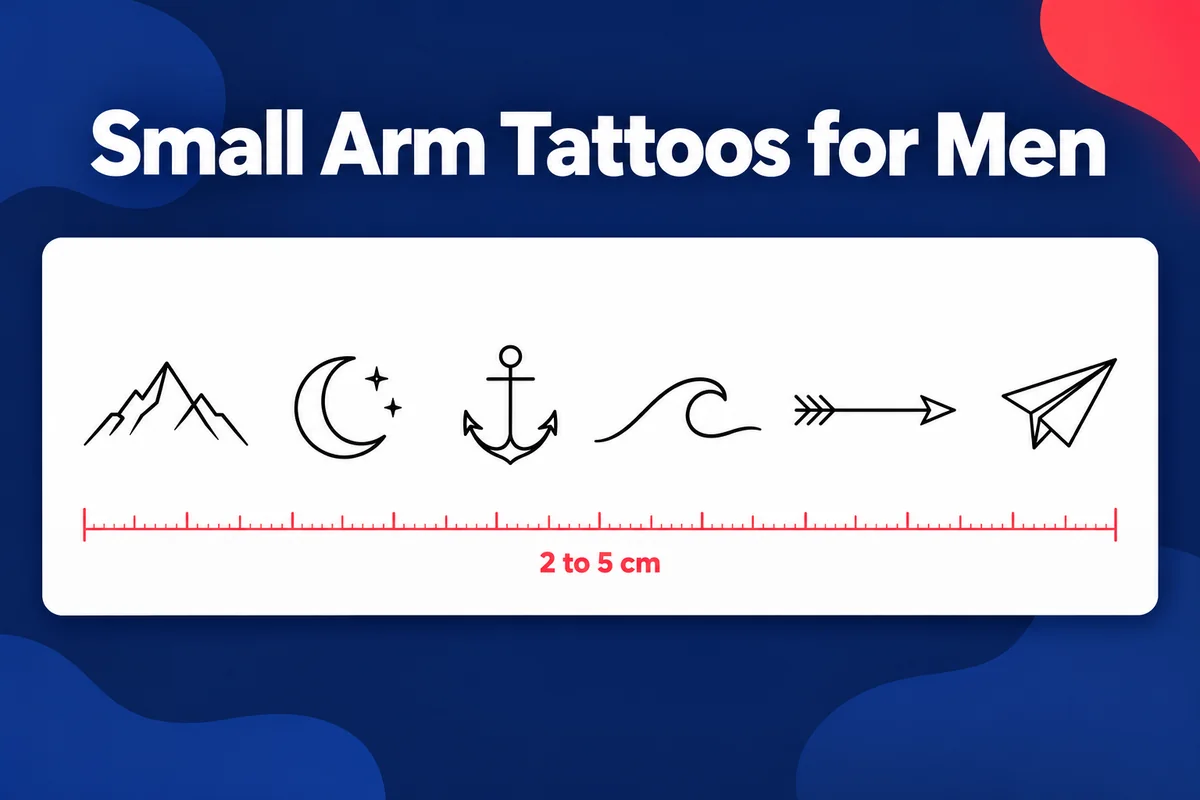
Small arm tattoos for men are a good first tattoo. They take one short session, cost less than a larger piece and leave the rest of the arm free for later. The wrist, the inner forearm, the back of the arm above the elbow and the side of the bicep all take small designs well.
Ten small arm tattoo ideas for men:
Single mountain peak. Three lines can say a lot.
Crescent moon. Works alone or with a few small stars.
Small anchor. A simplified anchor near the wrist.
Wave. One fine-line wave on the inner forearm.
Arrow. A short arrow running along the wrist.
Coordinates. The location of a place that matters, set in a clear typeface.
Playing card or dice. A small object with a personal story behind it.
Paper plane. A light, simple shape for travel.
Feather. A single feather along the inner forearm.
Lightning bolt. A small, bold shape that holds up well at a small size.
The rule for small tattoos is the same as for small text: leave space between lines. Lines that sit too close together can blur together over the years and turn a small design into a dark patch. An artist may ask you to go slightly bigger than you planned, and that advice is usually worth taking.
Sleeve Tattoos for Men: Half and Full Sleeves
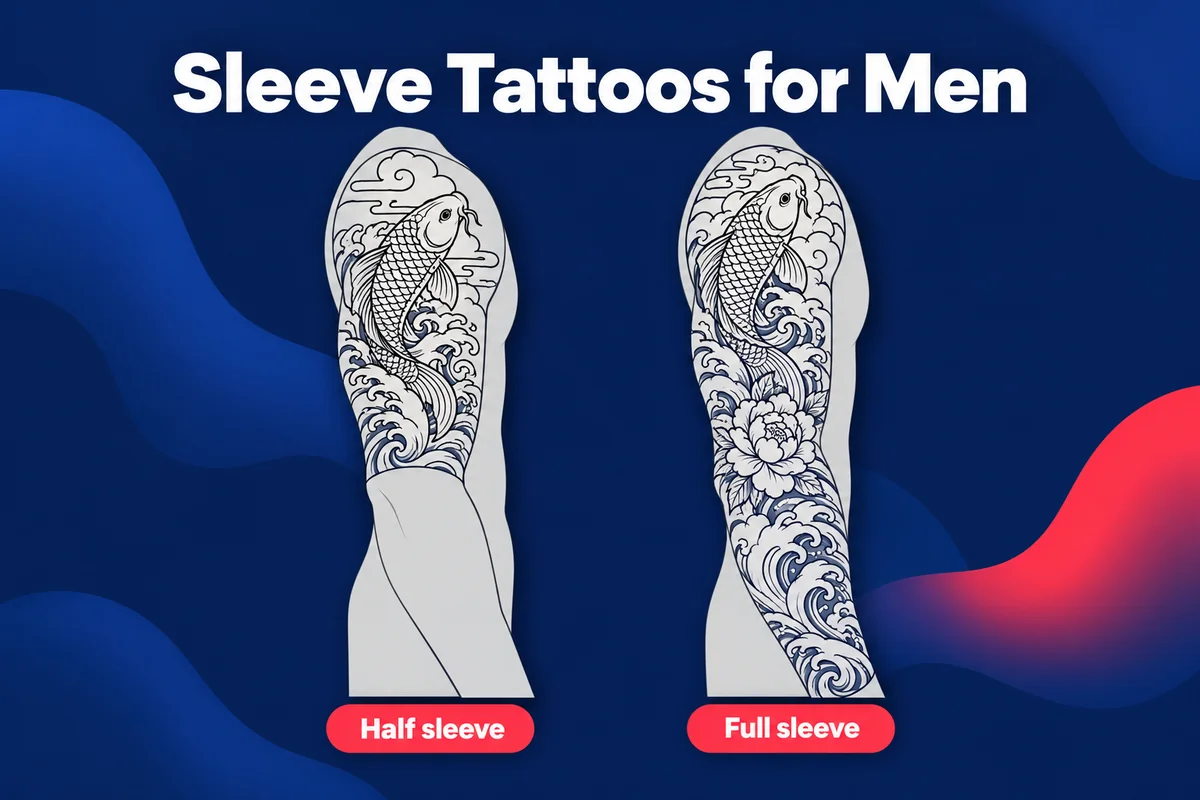
Sleeve tattoos for men cover most or all of the arm with one linked composition. A half sleeve runs from the shoulder to the elbow or from the elbow to the wrist; a full sleeve runs from the shoulder to the wrist. The Wikipedia entry on sleeve tattoos gives the history of the style, including its roots in Japanese full-body work.
A good sleeve is planned as one design, even if it is tattooed over many sessions. Most sleeves have three layers:
Main subjects, usually one or two larger pieces such as a dragon, a portrait of an animal or a ship.
Secondary pieces, smaller subjects that support the main one: flowers, smaller animals, objects.
Background, the clouds, waves, wind bars, smoke, geometric patterns or shading that link everything together.
Eight sleeve tattoo ideas for men:
Japanese koi and waves. A koi swimming up the arm with waves and wind bars as the background.
Forest to mountains. Trees at the wrist, mountains at the shoulder, with mist linking the two.
Ocean and ship. A ship in a storm with a lighthouse and an octopus as secondary pieces.
Geometric blackwork. Patterns that follow the muscles of the arm, with open space to keep it readable.
Space and planets. A planet, a rocket or an astronaut with stars as the background.
Biomechanical. Machine parts that look as if they sit under the skin. It needs a specialist artist.
Traditional patchwork. Separate traditional pieces with small fillers between them. It is the easiest sleeve to build over time, because each piece stands on its own.
Norse and Viking. Ravens, a helmet and knotwork patterns.
A half sleeve on the upper arm is the most common way to start. It can stay a half sleeve, or later continue down the forearm into a full sleeve if the first artist left a clear edge to continue from.
Our guide to sleeve tattoos for men goes further, with layouts for quarter, half and full sleeves and 45 themes.
Arm Tattoo Styles That Age Well
Every tattoo softens as the ink settles under the skin. Some styles keep their shape for decades; others need more care in the design.
Style
What it looks like
How it ages
Best arm placement
American traditional
Bold black outlines, limited colour
Holds up well because of the thick lines
Upper arm, forearm
Blackwork
Solid black areas and bold patterns
Holds up well; detail depends on open space
Sleeves, bands
Japanese
Large subjects with waves, clouds and wind bars
Holds up well when the outlines are bold
Sleeves
Fine line
Thin single-needle lines
Softens faster; needs good spacing
Inner arm, small pieces
Realism
Shading that looks like a photo
Depends heavily on the artist and contrast
Upper arm, forearm
Geometric
Precise lines and shapes
Holds its shape if the lines are not too thin
Forearm, sleeves
Two practical points apply to every style. Skin that sees a lot of sun fades faster, so the forearm needs more sun protection than the upper arm. And contrast matters: a design with clear black areas and clear open skin reads well from across a room, while a design that is all mid-grey can look flat after a few years.
How to Plan Your Arm Tattoo Design Before You Book
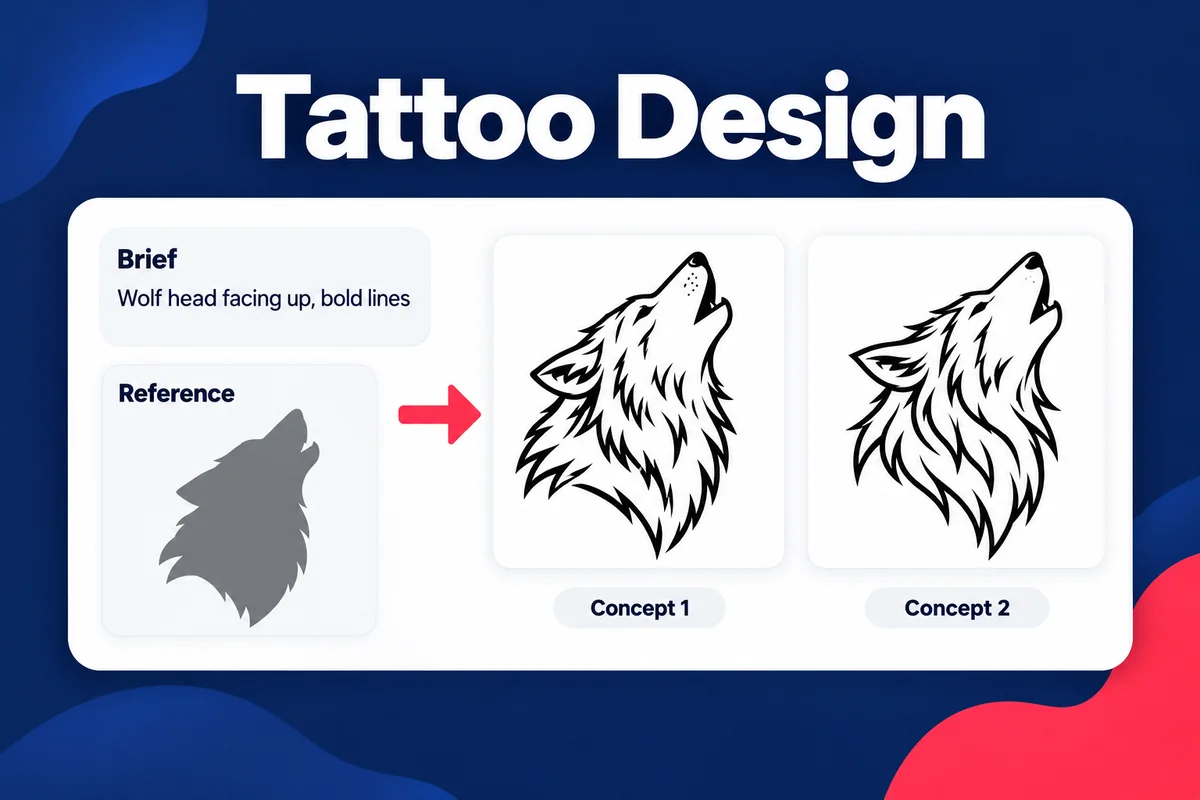
Most men arrive at a consultation with a few saved photos and a vague idea. Artists can work with that, but a clear brief gets you a better first draft and a shorter conversation. A brief covers five things:
Subject. One clear subject, such as "a wolf head facing up" rather than "something with a wolf, a moon and the forest."
Placement. Outer forearm, inner arm, upper arm, bicep or part of a planned sleeve.
Size. Measure the space on your arm with a ruler. Sizes in centimetres or inches avoid confusion.
Style. Traditional, blackwork, fine line, Japanese, realism or geometric.
Meaning. Why it matters to you, so the artist knows which details to keep.
A quick way to test an idea before you book is to see it drawn. The tattoo design template in Potto AI takes a short brief of up to 200 characters and an optional reference image, and returns two concepts in clean linework on a plain white background. The template draws only the design: no skin, no body parts and no lettering, so you judge the shapes rather than a mock-up. Compare the two concepts for line clarity, silhouette and open space, then bring the one you like to your artist as a discussion reference.
Briefs that work well in the template are short and specific:
"A wolf head facing upward, fur drawn as bold directional lines, long vertical layout"
"A compass with a mountain range inside the outer ring, simple needle"
"A single pine tree with roots, tall and narrow"
"A lion head with a full mane, round composition"
"A koi fish swimming upward with two small waves"
Treat every concept as a starting point. Check that limbs, leaves and objects connect correctly, and that repeated elements have not changed in number. A tattoo artist still has to redraw the design for your arm, adjust line weight for the size you choose and make a stencil. If you want to explore wider ideas first, such as a full colour reference for a sleeve, the AI image generator in Potto creates images from a text prompt and reference images, which you can then simplify into a tattoo brief.
Arm Tattoo Pain, Cost and Healing
Pain. How much an arm tattoo hurts depends on the spot and on you. Fleshier areas with thicker skin, such as the outer upper arm and the outer forearm, are generally described as more manageable. Areas near bone or with thin, soft skin, such as the inner arm, the elbow and the wrist, are generally described as more sensitive. Long sessions are harder than short ones, which is one reason sleeves are split into several appointments.
Cost. Artists price by the piece or by the hour, and rates vary widely by city, studio and experience. A small arm tattoo is usually a single short session, an upper arm piece may take one longer session, and a full sleeve is a project of many sessions. Ask for a quote after the consultation, when the size and detail are clear, and choose the artist for their healed work rather than for the lowest price.
Healing. Cleveland Clinic's dermatologist-backed guide to tattoo aftercare sets out a typical timeline:
Keep the bandage your artist applies on for at least a few hours, then soak it in warm water and remove it gently.
In the first week, wash the area twice a day with mild, fragrance-free soap and lukewarm water, pat it dry and moisturize it.
In weeks two to four, itching, flaking and some scabbing are normal. Do not pick the scabs.
Until it is fully healed, keep the tattoo out of direct sun and do not soak it in pools, baths or hot tubs.
Smaller tattoos on the arms often heal faster than those on the chest or back. The top layer of skin is typically healed in about two months, while deeper layers take longer.
Seek medical care for fever, skin that is hot to the touch, worsening pain or redness that keeps spreading. The American Academy of Dermatology's page on caring for tattooed skin covers long-term care, and its other pages, listed under Sources, explain skin reactions and why a tattoo can make skin cancer harder to spot.
Common Mistakes With Arm Tattoos
Choosing a design before the placement. A wide design on a narrow forearm wraps around the arm and is never fully visible.
Going too small. Tiny text and tight detail blur first. Let the artist size the design.
Ignoring the future sleeve. If you might add more later, say so before the first piece is placed.
Copying another person's tattoo. Use other tattoos as references for style, then let your artist draw something original for you.
Skipping sun protection. Forearm tattoos fade faster without it once they are healed.
Arm Tattoos for Men FAQs
What are the best arm tattoos for men?
The best arm tattoos for men are designs that fit their placement: long vertical designs such as a compass, a wolf or an arrow on the forearm; round or square designs such as a lion, an eagle or a clock on the upper arm; and linked compositions such as a Japanese koi or a forest in a sleeve. Bold lines and clear open space make any of them age better.
Where should a man get his first arm tattoo?
The outer upper arm is the most common place for a first arm tattoo because it is easy to cover, the skin is thick and there is room for a medium design. The outer forearm is the choice for men who want to see the tattoo every day.
Do forearm tattoos for men hurt?
Forearm tattoos for men are usually described as one of the more manageable placements on the outer side of the arm. The inner forearm, the wrist and the area near the elbow are generally more sensitive.
How long does a sleeve tattoo take?
A sleeve tattoo takes many sessions spread over weeks or months, depending on the size, the detail and how fast your skin heals between appointments. A half sleeve takes fewer sessions than a full sleeve.
What is the difference between a half sleeve and a full sleeve?
A half sleeve covers either the upper arm (shoulder to elbow) or the forearm (elbow to wrist). A full sleeve covers the whole arm from the shoulder to the wrist as one composition.
Can I design my own arm tattoo with AI?
Yes, as a starting point. A tattoo design tool such as the Nano Banana Pro powered tattoo design template in Potto AI turns a short brief into two linework concepts. A tattoo artist still has to redraw the concept for your arm, choose the line weight and make the stencil.
How do I take care of a new arm tattoo?
Keep the first bandage on for a few hours, wash the tattoo gently twice a day with mild, fragrance-free soap, moisturize it, avoid soaking it and keep it out of direct sun until it has healed. Follow your artist's instructions and see a doctor if you notice signs of infection.