MiniMax H3 vs H3 Image: H3 makes video with sound, H3 Image makes 4K pictures. Compare Standard and Highspeed, credits, test times, text and references.
Short answer: MiniMax H3 is MiniMax's video model line, and MiniMax H3 Image is its image model. H3 makes video clips with sound, up to 15 seconds at 2K. H3 Image makes still pictures, up to 4K (4096 × 4096). Potto offers MiniMax H3 Image in two versions, Standard and Highspeed, and does not offer the H3 video models.
The names are close, so searches mix them up. Both come from MiniMax. Both have a model called Highspeed. And MiniMax says H3 Image is built on H3. This guide sets out MiniMax H3 vs H3 Image side by side, then compares the two image versions with prices, our own test times and the text results. Every MiniMax figure comes from MiniMax's own pages, checked on November 12, 2026.
Key facts (checked November 2026):
MiniMax launched MiniMax H3 on July 31, 2026, as a model that generates video with stereo sound, up to 15 seconds at 2K.
MiniMax launched MiniMax H3 Image on November 11, 2026, as an image model built on H3.
MiniMax says MiniMax H3 Image can make a 4096 × 4096 image in under 10 seconds.
MiniMax lists text-to-image at $0.02179 per 1K image on Standard and $0.03529 on Highspeed.
On Potto, MiniMax H3 Image costs 10 credits at HD on Standard and 15 credits on Highspeed.
MiniMax H3 vs MiniMax H3 Image
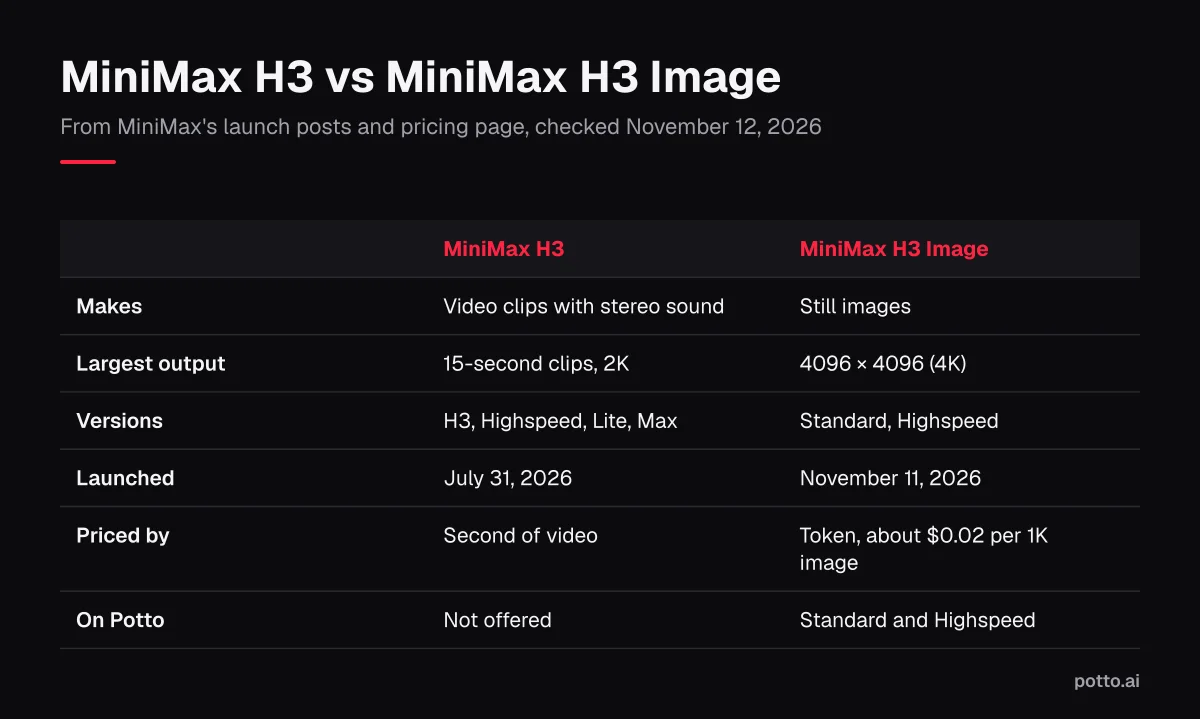
MiniMax H3 is a video model. MiniMax H3 Image is an image model. That is the whole difference in one line. The table below fills in the details from MiniMax's launch posts and its pricing page.
Per second of video ($0.08 at 768P for MiniMax-H3)
Per token ($0.02179 for a 1K image on Standard)
On Potto
Not offered
Standard and Highspeed
The MiniMax H3 video models
MiniMax's pricing page lists four MiniMax H3 video models. MiniMax-H3 costs $0.08 per second at 768P and $0.13 per second at 2K. MiniMax-H3-Highspeed costs $0.06 per second at 768P. MiniMax-H3-Lite costs $0.04, and MiniMax-H3-Max costs $0.08, both at 768P. The MiniMax H3 video models are priced per second of output, like most video models. None of them returns a still image, so a poster or a product shot needs H3 Image instead.
Why the names get mixed up
MiniMax calls H3 "a general-purpose multimodal generation model". Its launch post describes video with native stereo sound, up to 15 seconds at 2K. Four months later, MiniMax released H3 Image and described it as an image model built on H3. So the two share a name and a base, but not an output.
The Highspeed label adds to the mix. MiniMax-H3-Highspeed is one of the H3 video models. MiniMax-H3-Image-Highspeed is an image model. If you read "H3 Highspeed" in a post, check whether it means a clip or a picture. The price unit is a simple tell: per second means video, per token or per image means an image.
Which one you need
The MiniMax H3 vs H3 Image choice comes down to motion. Pick MiniMax H3 Image when you need a poster, a product shot, a character or an edit of your own photo. Pick one of the MiniMax H3 video models when you need moving footage with sound. On Potto, the image models live in the image creator. For video clips with sound, Potto uses Seedance 2.5 instead, so the MiniMax H3 video models are not part of the menu.
MiniMax H3 Image Standard and Highspeed
MiniMax H3 Image Standard and Highspeed are the two versions of the model. They are the same model family with the same options. They differ in speed and price. The MiniMax H3 Image Highspeed version returns images sooner and costs more.
Price in credits
MiniMax H3 Image on Potto is priced per image. The price depends on the version, the size and the number of reference images. The Generate button shows the total first.
Size
MiniMax H3 Image Standard
MiniMax H3 Image Highspeed
HD
10 credits
15 credits
2K
10 credits
15 credits
4K
26 credits
47 credits
MiniMax H3 Image Highspeed costs 50% more than Standard at HD and 2K, and about 81% more at 4K. MiniMax's own list prices follow the same pattern. Standard text-to-image is $0.02179 at 1K, $0.02333 at 2K and $0.06879 at 4K. Highspeed is $0.03529, $0.03622 and $0.13001. MiniMax runs a 50% discount on 4K requests until November 17, 2026. Potto credits follow the regular list price, not the promotion.
Speed: what MiniMax says and what we measured
MiniMax says Standard runs 1.5 to 2 times as fast as mainstream alternatives, and Highspeed 3 to 4 times. It does not name the baseline. So we timed the two versions ourselves.
On November 12, 2026, we ran three prompts on each version at HD and 3:4, one run per prompt. Standard took 11.3 to 14.5 seconds per image. Highspeed took 9.0 to 10.9 seconds. Highspeed was sooner on all three prompts, by 0.4 to 4.7 seconds. That is a small sample, not a promise. Times change with load, size and prompt.
Which version to start with
Start with MiniMax H3 Image Standard. It costs less and gives the same kind of result. Switch to MiniMax H3 Image Highspeed when you test many prompts in a row and the wait slows you down. The MiniMax H3 Image Highspeed costs are worth it only when time matters more than credits.
Prompts and Text in Images
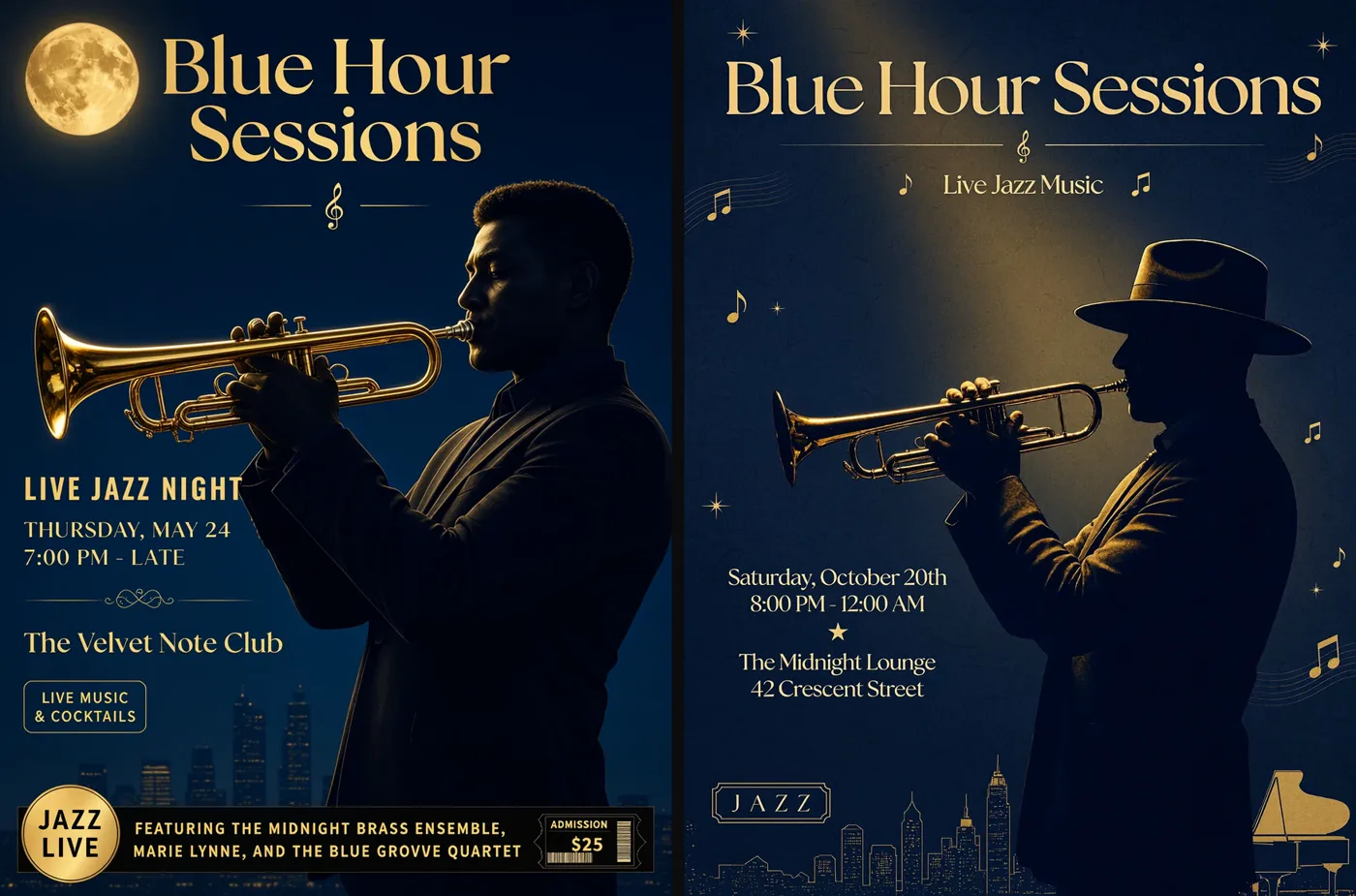
We used the same three prompts for both versions: a poster, a product shot and a character. The poster prompt asked for one headline:
A bold poster for a jazz night, the headline "Blue Hour Sessions" in big serif letters, a trumpet player in silhouette, deep blue and gold
Both MiniMax H3 Image Standard and Highspeed spelled "Blue Hour Sessions" correctly. Both also added lines we did not ask for: a date, a venue and, on Standard, a ticket price. The small print on the Standard poster has a slip: "GROVVE" where "GROOVE" was likely meant.
This comes from prompt rewriting. MiniMax H3 Image rewrites each prompt with extra detail before it draws, and edits are always rewritten. A short prompt can gain scenery and text. To stay close to your idea, say what to leave out, such as "no text". Put any words you need in quotes, and read every word of the result.
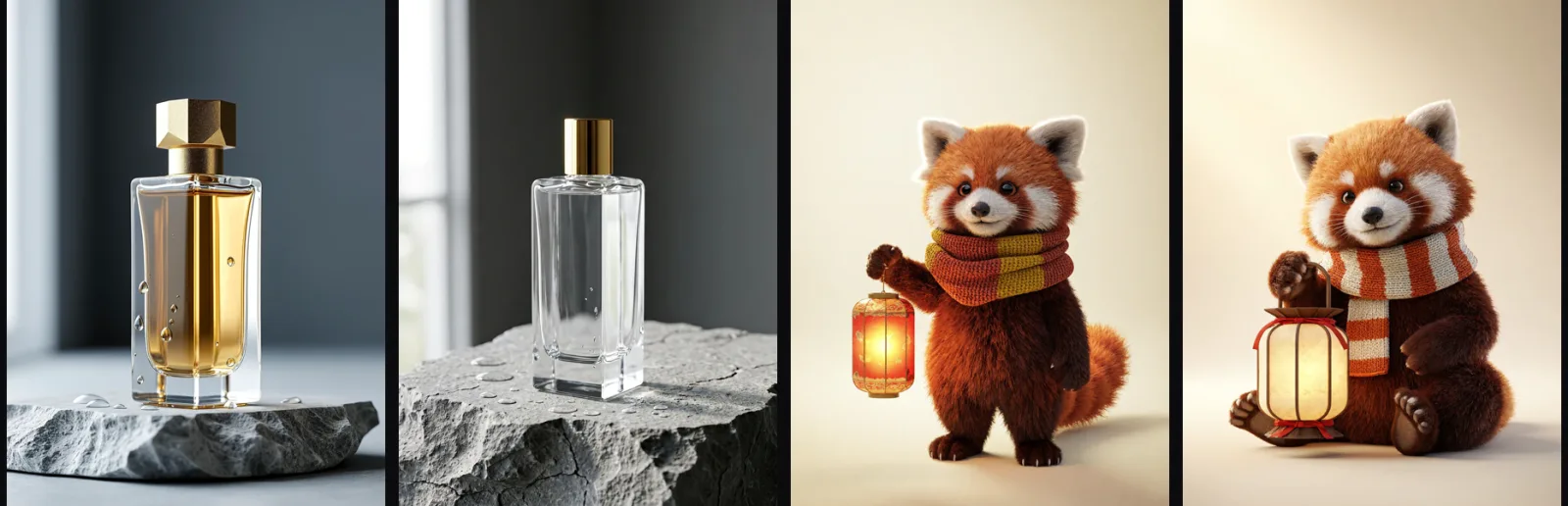
The product and character prompts had no text to spell. Both Standard and Highspeed kept the subject, the light and the palette from the prompt. The two results differ in framing and detail, as two runs of any model do.
Reference Images
You can edit with up to 14 reference images in MiniMax H3 Image on Potto. MiniMax's launch post says the model handles up to 16. Give each of the reference images one job, such as the face, the product or the palette, and say what stays and what changes. A reference guides the result. It is not an exact copy, so check faces, labels and shapes against the source.
Each reference adds a little to the price on both Standard and Highspeed, and MiniMax H3 Image Highspeed costs more per reference. MiniMax bills input images by token, so an edit with more references costs more.
References
Standard, HD
Highspeed, HD
None
10 credits
15 credits
1
12 credits
19 credits
3
16 credits
25 credits
14
39 credits
62 credits
Reference images cannot include a mask, and transparent backgrounds are not supported. To cut out a subject, run the finished image through a background remover afterwards.
Sizes and Formats
MiniMax H3 Image on Potto offers HD, 2K and 4K, with ten aspect ratios from 1:1 to 21:9. A square image is 1024 × 1024 at HD, 2048 × 2048 at 2K and 4096 × 4096 at 4K. HD and 2K files are PNG. 4K files are JPEG. You can make 1, 2 or 4 images per request, and each image costs the same.
When to Pick Another Model
MiniMax H3 Image is one of several image models in the same creator. The AI models list compares them all. Two are close alternatives, and the notes below use only each vendor's published figures.
Nano Banana 2.1
Nano Banana 2.1 is Google's high-efficiency image model. Google's model card reports an overall preference Elo of 1050 for it with thinking on, against 935 for Nano Banana Pro, in Google's own test. Google lists it at $0.0336 per 1K image. On Potto it costs 12 credits at HD and 38 at 4K, and takes up to 10 references. Try it when you want a second opinion on the same brief.
GPT Image 2.6
GPT Image 2.6 comes as Flare and Sunburst, two OpenAI models. OpenAI's image guide says both support SVG output and markup-guided edits. On Potto each costs 15 credits at HD and 49 at 4K. Try it when you need an SVG file, which MiniMax H3 Image does not make.
For a single prompt across models, the AI image generator lets you switch the model without leaving the page.
Write a prompt, or add reference images and give each one a job.
Pick the aspect ratio, the size and the number of images.
Read the credit price on the button, then generate.
Check the result at full size, especially any text.
FAQs
Is MiniMax H3 Image the same as MiniMax H3?
No. In MiniMax H3 vs H3 Image terms, one makes clips and one makes pictures. MiniMax H3 is a video model that makes clips with stereo sound, up to 15 seconds at 2K. MiniMax H3 Image is an image model built on H3 that makes still pictures up to 4096 × 4096. Potto offers the image model only, not a MiniMax H3 video model.
What is the difference between Standard and Highspeed?
Standard and Highspeed are two versions of MiniMax H3 Image with the same options. MiniMax H3 Image Highspeed returns images sooner and costs more: 15 credits at HD on Potto, against 10 for Standard. In our six test runs at HD and 3:4, Standard took 11.3 to 14.5 seconds and Highspeed took 9.0 to 10.9 seconds.
Can MiniMax H3 Image write text in an image?
Yes, with checks. Both versions spelled the headline "Blue Hour Sessions" correctly in our test. The model also added lines we did not ask for, and one small line had a spelling slip. Put the exact words in quotes and read every word of the result.
How many reference images does it take?
MiniMax H3 Image on Potto takes up to 14 reference images. MiniMax's launch post says the model handles up to 16. Each reference adds a little to the price, from 10 credits with none to 39 credits with 14 on Standard at HD.
What sizes does MiniMax H3 Image make?
MiniMax H3 Image makes HD, 2K and 4K images in ten aspect ratios from 1:1 to 21:9. A square image is 1024 × 1024 at HD and 4096 × 4096 at 4K. HD and 2K files are PNG, and 4K files are JPEG.
Sources
All pages were read on November 12, 2026. Prices and promotions are the vendors' and may change.